For hotels
Why guests don’t use services your hotel already offers
Your hotel may already provide extra pillows, hygiene essentials, late check-out, room service, wellness, transfers and other services. Yet some guests never use them during their stay.
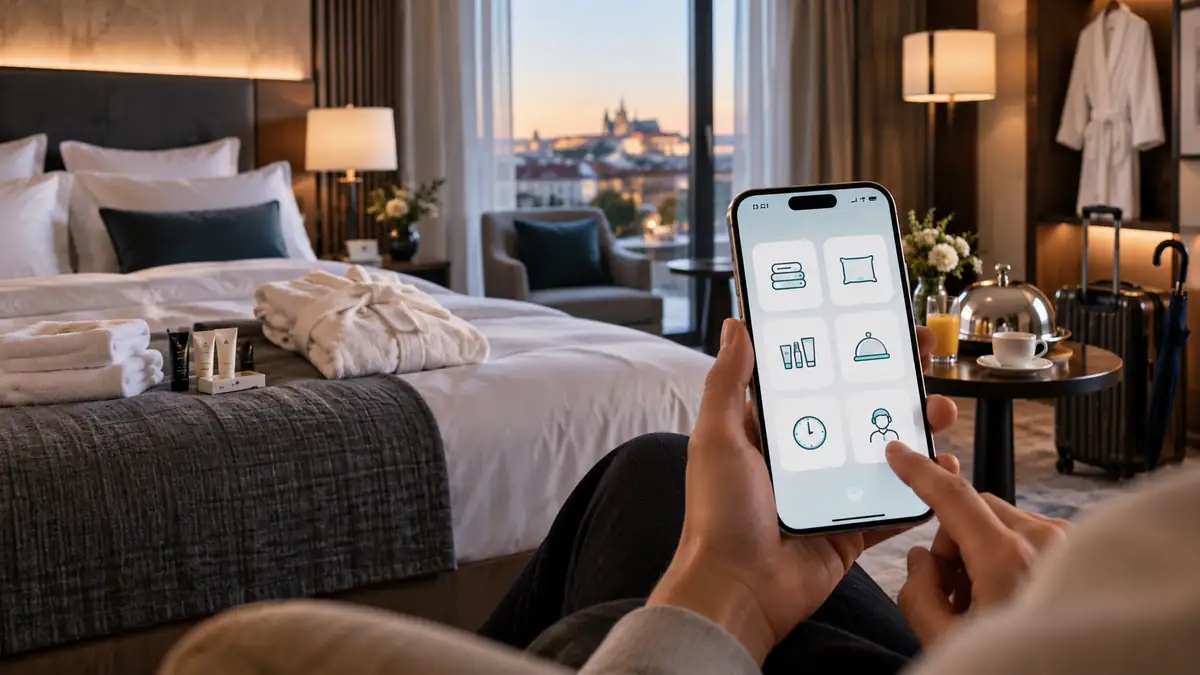
Not because guests do not need them. Often, they simply do not know the services exist, are unsure whether they can ask for them, or face too much friction in making the request.
It is an odd hotel-operations paradox: the hotel invests in the service, staff and equipment, but the final few metres between the hotel’s offer and the guest’s need do not work.
That is where part of the value the hotel has already created disappears.
A hotel can have the service. The guest still needs to know about it.
Imagine a simple situation. A guest arrives in the evening and realises they left their toothbrush at home.
The hotel has hygiene essentials ready at reception, but the guest does not know that. They may search for the nearest shop, order something for delivery or simply decide to wait until morning.
The hotel had the solution only a few floors away.
The same guest may wait until the next cleaning round for fresh towels without knowing they can request a replacement. They may not know the hotel offers an extra pillow, bathrobe, umbrella, charging adapter, luggage storage or late check-out.
The existence of a service does not automatically make it accessible to the guest. It also has to be visible.
If you want to see how broad the hotel service offer can be, start with our overview of services by star category.
Service information is often scattered
One part of the offer sits on the website. Another part is in the in-room directory. Something else appears in the pre-arrival email, on a card by reception or only in the heads of staff.
From the hotel’s point of view, everything may be documented correctly. From the guest’s point of view, there is still one very simple question:
“What can I actually use here?”
A guest staying for three nights does not want to study hotel documentation. They want to know within seconds whether the hotel can solve their immediate need.
The amount of information therefore matters less than its availability at the moment the guest needs it.
Calling reception is a bigger barrier than it may appear
The traditional answer is: “The guest can just call reception.” Of course they can. But possibility is not the same thing as a convenient path.
The guest has to find the right number, explain the request and sometimes do it in another language. Reception may be handling arrivals, the line may be busy, or the guest may simply not want to bother anyone for two towels.
For some guests, a phone call is completely natural. For others, it is unnecessary friction.
And the smaller the request, the larger the ratio can become between its value and the effort required to submit it. You will probably call about a broken air conditioner. For one extra pillow, perhaps not.
Guests often do not know whether a service is free
Another barrier is surprisingly simple: price.
A guest may see late check-out, a transfer or laundry, but not know whether it is included, paid, or even available in their situation.
Uncertainty delays the decision.
The hotel can remove that uncertainty with a few words: Included. On request. €15 supplement. Available until 22:00.
The less the guest has to guess, the easier it becomes to use the service. This matters even more for services the hotel wants to sell.
The service has to appear at the right moment
A guest probably does not need an offer for late check-out three weeks before arrival. The evening before departure, it can suddenly be highly relevant.
They do not need information about towel replacement while booking. They need it while standing in the bathroom wanting a fresh towel.
Good guest experience is therefore not just a list of services. It is the ability to make the right service available at the moment of need.
This is where digital tools have a fundamental advantage over a paper directory.
The problem does not end when the request is sent
Even a perfect guest interface is not enough on its own.
Imagine the guest requests fresh towels with one tap. What happens next?
Does reception receive it? Housekeeping? A specific employee? Does the receptionist have to call someone? Write it on paper? Send a message to a group? And who later knows whether the request was actually completed?
This is where a simple “guest app” problem becomes an hotel operations problem.
A digital request creates real value only when it becomes a task, reaches the right person and somebody confirms completion.
Otherwise, the hotel has merely replaced a phone call with a different form of chaos.
An unused service is not only a guest problem
If the guest does not know about a service, the hotel loses more than an opportunity to make a good impression.
With paid services, it may lose revenue directly. Late check-out, wellness, breakfast, transfers, room service and other add-ons can generate additional revenue from a guest the hotel has already acquired.
With free services, the economics are less direct but still important. A quickly solved problem can mean a happier guest. A small unresolved problem may surface only later in a review.
Another problem: hotels often do not know what guests really need
A phone call disappears. A conversation at reception disappears. A housekeeping note disappears. And the data disappears with them.
Management then struggles to answer simple questions: How often did guests request more towels? How many requests concerned cleaning? How often did the same technical issue appear? How many guests wanted late check-out? How quickly were requests handled? Which services are barely used?
Without structured data, guest experience is judged largely by impressions, individual complaints and the final reviews.
That is a fairly late way to discover that something was not working.
A hotel does not need another complicated app
The answer is not to add another obligation for the guest.
A guest staying two or three nights probably does not want to download an app, create an account, verify an email address, set a password and learn a new system just to request a towel.
The digital path has to be simpler than making a phone call. Otherwise, it serves no purpose.
A practical version can be much simpler:
In-room QR code → mobile web → hotel services → submit request.
No installation. No registration. No searching for a number.
And on the hotel side: request → right department → task → completion.
Digitising a menu is not enough. The guest has to connect to operations.
A hotel microsite is useful. A digital menu is useful. A QR code is useful.
But the real operational benefit appears only when the whole chain is connected:
guest need → request → responsibility → fulfilment → confirmation.
This final step often determines whether a digital service genuinely saves work or simply creates another channel somebody has to monitor.
What should a simple digital journey look like?
A guest should not open the hotel interface and see a catalogue of fifty items. They should understand quickly what they can do.
For example: Room: towels, cleaning, hygiene essentials, extra pillow. I need help: report a problem, contact the hotel. Services: late check-out, room service, wellness, transfer.
The actual offer should of course reflect the services of the specific hotel. A four-star city hotel will have different needs from a mountain resort or an aparthotel.
The point is not to force every hotel into the same universal list. The point is to make the specific offer of a specific hotel available in a form the guest immediately understands.
For an idea of how broad higher-category service can be, see our guides to 4-star and 5-star hotels.
This is where Pikolee comes in
We are building Pikolee as a lightweight digital layer between the guest and hotel operations.
The guest scans a QR code, opens a mobile interface without installing an app and chooses a service or request. The hotel receives a structured task instead of another vague phone call or message.
The long-term goal is not merely to digitise towel requests. The value sits in the whole process:
Guest intent → Pikolee → right team → operational task → fulfilment → confirmation to the guest.
The hotel can then make services easier to access and gradually learn what guests actually need, how quickly requests are handled and where unnecessary operational friction occurs.
You do not need to replace the whole hotel system first
A fair question for a hotel is: “Do we need another major PMS integration for this?”
Not necessarily.
The first step can be much simpler. Select a few frequent requests. Make them available through a QR code. Route them to staff in a simple way. Then measure whether guests use them and whether the new process actually reduces work.
Only when that basic workflow works does it make sense to add deeper integrations, automation or a wider service catalogue.
Technology should follow operational value. Not the other way around.
Perhaps the problem is not the hotel’s service offer
A hotel can have a very good range of services, capable staff and a high service standard, while part of that value remains invisible.
There is still a gap between what the hotel can provide and what the guest can easily access.
Closing that gap may be one of the simplest ways to improve guest experience without adding any new services.
Sometimes the hotel does not need to offer more. It needs to make what it already offers easier to use.
Further reading
Want to see how broad a hotel service offer can be? See what guests can request during a stay.
For higher categories, we have separate guides to 4★ hotels and 5★ hotels.